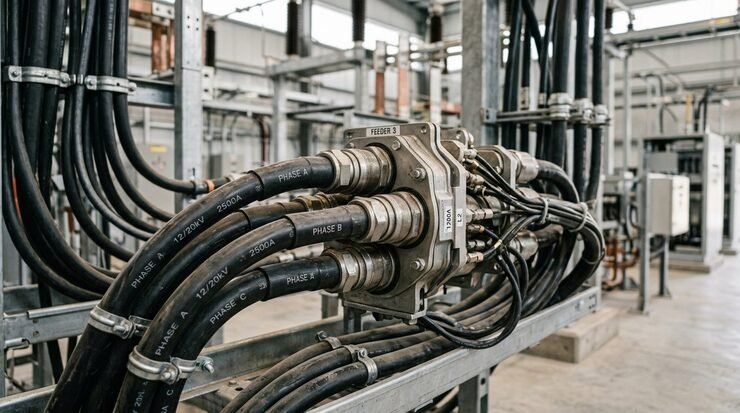
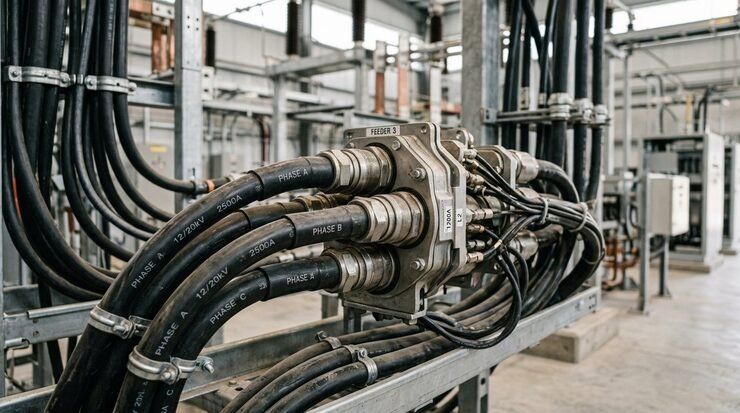
Industrial power cables are electrical conductors designed to transmit and distribute electrical power across manufacturing facilities, utilities, infrastructure projects, renewable-energy installations, mining operations, and other demanding environments. They are engineered around voltage, current, temperature, mechanical stress, environmental exposure, and installation requirements.
A typical power cable consists of one or more conductors surrounded by insulation and, depending on its application, shielding, metallic armor, protective sheathing, fillers, and other layers.
Why Industrial Power Cables Matter
Industrial electrical systems require reliable transmission of power between generators, transformers, switchgear, motors, control equipment, and production machinery. Cable construction directly affects electrical performance, safety, mechanical durability, and service life.
Industrial cables may operate in environments involving heat, oil, moisture, chemicals, vibration, abrasion, or mechanical movement. Selecting an appropriate cable therefore requires more than simply matching voltage and conductor size.
Important considerations include conductor material, insulation type, current-carrying capacity, voltage rating, installation method, ambient temperature, bending requirements, and environmental protection.
Types of Industrial Power Cables
Low-Voltage Power Cables
Low-voltage cables are commonly used for facility distribution, machinery connections, motors, lighting systems, and industrial electrical equipment.
Medium-Voltage Power Cables
Medium-voltage cables are used for industrial distribution networks, substations, transformers, large motors, and other higher-power installations.
High-Voltage Power Cables
High-voltage cables are designed for major power-transmission and distribution applications. Their insulation and shielding systems require careful electrical and thermal design.
Armored Power Cables
Armored cables incorporate metallic protection around the cable structure. They can provide additional mechanical protection in demanding installation environments.
Flexible Industrial Power Cables
Flexible cables are designed for applications where repeated movement, bending, or mechanical positioning occurs. They are used with industrial machinery, automation equipment, cranes, and mobile systems.
Shielded Power Cables
Shielding helps control electromagnetic interference and electrical field distribution. Shielded designs are commonly used where electromagnetic compatibility is important.
Materials Used in Industrial Power Cables
Power cable construction combines conductive, insulating, shielding, and protective materials.
| Material | Primary Function |
|---|---|
| Copper | High electrical conductivity |
| Aluminum | Lightweight electrical conductor |
| XLPE | Electrical insulation |
| PVC | Insulation and sheathing |
| EPR | Flexible insulation |
| Steel | Mechanical armor |
| Aluminum foil | Shielding |
| Copper tape | Electrical shielding |
Copper is widely used where high conductivity and compact conductor dimensions are required. Aluminum can provide lower weight and is used in many power-distribution applications.
Insulation materials are selected according to voltage, temperature, flexibility, environmental exposure, and mechanical requirements.
Industrial Power Cable Manufacturing Technologies
Power cable manufacturing involves several controlled production stages.
1. Conductor Preparation
Copper or aluminum wire is drawn and processed to achieve the required diameter and electrical characteristics. Multiple wires may then be stranded together to form the conductor.
2. Insulation Extrusion
The conductor passes through an extrusion line where insulation material such as XLPE, PVC, or EPR is applied at controlled thickness.
3. Screening and Shielding
Medium- and high-voltage cables may incorporate semiconductor screens, metallic screens, copper tapes, wires, or other shielding structures.
4. Cable Assembly
For multicore cables, insulated conductors are assembled together with fillers and binding materials to establish the required geometry.
5. Armoring
Where mechanical protection is required, steel wire, steel tape, or other armor may be applied around the cable.
6. Outer Sheathing
A protective sheath is extruded over the cable assembly. Sheathing materials are selected according to environmental and mechanical requirements.
7. Testing
Finished cables undergo electrical and mechanical testing. Depending on the cable type, tests can include conductor resistance, insulation resistance, high-voltage testing, dimensional inspection, and sheath testing.
Automation in Cable Manufacturing
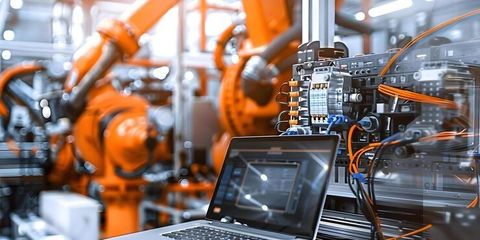
Modern cable factories use automated extrusion lines, wire drawing equipment, stranding machines, take-up systems, laser diameter measurement, and computerized process controls.
Online monitoring can continuously measure conductor dimensions, insulation thickness, extrusion temperature, line speed, and other parameters.
Automated inspection systems can identify dimensional variations and surface defects during production. Digital production records can also support batch traceability and quality management.
Industrial Power Cable Comparison
| Cable Type | Main Characteristic | Typical Applications |
|---|---|---|
| Low voltage | Facility and equipment distribution | Manufacturing |
| Medium voltage | Higher-power distribution | Plants and substations |
| High voltage | Major power transmission | Utilities and infrastructure |
| Armored | Mechanical protection | Industrial installations |
| Flexible | Repeated movement | Machinery and automation |
| Shielded | Electromagnetic control | Industrial electrical systems |
Industrial Power Cable Cost Factors
The cost of an industrial power cable depends on conductor material, conductor size, voltage rating, insulation system, cable construction, shielding, armor, sheath material, production volume, and testing requirements.
Copper conductors can have different material economics from aluminum conductors. Specialized cables designed for high temperatures, chemical exposure, repeated movement, fire resistance, or other demanding environments may require more complex materials and construction.
Additional procurement factors include cable length, packaging, transportation, installation requirements, testing documentation, and project-specific specifications.
Global Manufacturers and Suppliers
The industrial power cable market includes cable manufacturers, electrical equipment companies, distributors, wholesalers, engineering firms, and specialized cable suppliers.
When evaluating an industrial power cable manufacturer or supplier, technical factors can include:
Voltage rating
Current capacity
Conductor material
Insulation material
Temperature rating
Shielding configuration
Armor construction
Flexibility
Fire and environmental performance
Testing and certification documentation
For large industrial projects, procurement teams may require custom cable dimensions, specific insulation systems, specialized jackets, or project-specific testing.
Industrial Applications
Industrial power cables are used in many sectors:
Manufacturing plants
Mining operations
Oil and gas facilities
Power generation
Renewable-energy projects
Chemical plants
Steel mills
Data centers
Infrastructure projects
Automotive factories
Marine installations
Transportation systems
Mining environments may require heavy-duty and mechanically protected cables, while renewable-energy systems can require specialized cables designed for solar or wind applications.
How to Select Industrial Power Cables
Before selecting a cable, evaluate:
Operating voltage
Required current capacity
Conductor material
Cable length
Installation method
Ambient temperature
Mechanical stresses
Chemical and moisture exposure
Flexibility requirements
Applicable electrical standards
Cable sizing should account for factors such as allowable temperature rise, installation conditions, grouping, ambient temperature, and voltage drop.
Frequently Asked Questions
What are industrial power cables?
Industrial power cables are electrical cables designed to transmit and distribute electrical energy in manufacturing, infrastructure, utility, mining, and other industrial environments.
What materials are used in power cables?
Copper and aluminum are common conductor materials, while XLPE, PVC, and EPR are widely used insulation materials. Steel and other metals can provide shielding or mechanical protection.
What is the difference between low-, medium-, and high-voltage cables?
They are designed for different voltage ranges and applications, with insulation, shielding, construction, and testing requirements varying according to the operating voltage.
Why are industrial cables armored?
Armor provides additional mechanical protection against impact, crushing, abrasion, and other physical stresses during installation or operation.
What affects industrial power cable selection?
Voltage, current, conductor material, insulation, temperature, installation conditions, mechanical stresses, environmental exposure, flexibility, and applicable standards all influence cable selection.
Conclusion
Industrial power cables provide essential electrical connections for manufacturing facilities, power infrastructure, renewable-energy projects, mining operations, and numerous other applications. Low-, medium-, and high-voltage cables, along with armored, flexible, and shielded configurations, address different electrical and environmental requirements.
Advances in conductor processing, insulation extrusion, automated production, online inspection, and digital quality control are improving cable manufacturing consistency. Proper cable selection requires careful evaluation of electrical load, installation conditions, environmental exposure, mechanical requirements, and applicable technical standards.